
Outline
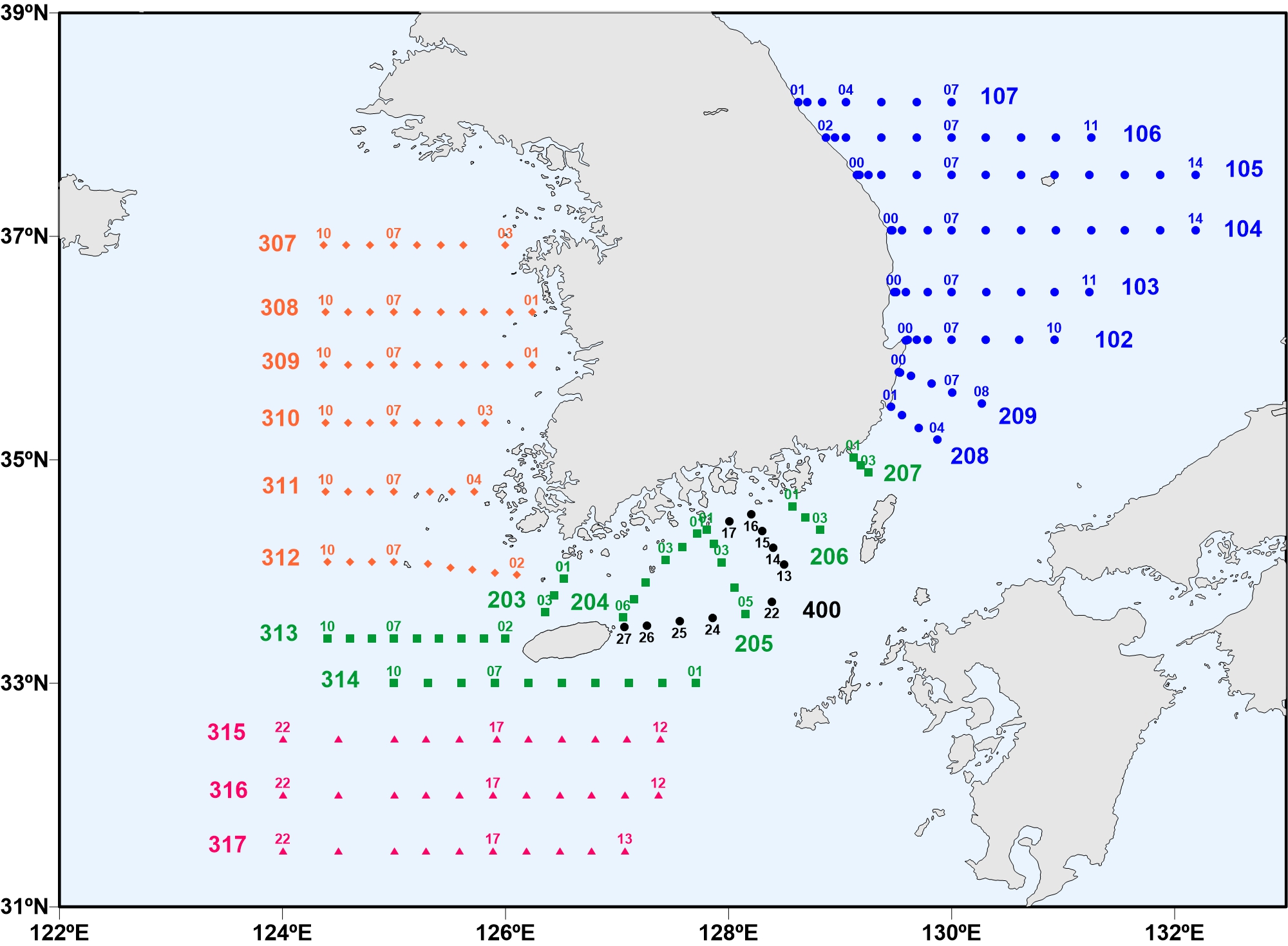
| 해역 | 지점명 | 조사주체 | 비고 |
|---|---|---|---|
| East Sea | 8 lines 69 stations : 102, 103, 104, 105, 106, 107, 208, 209 |
East Sea Fisheries Research Instiute Climate and Environmental Resources Division | Tamgu No.3 |
| West Sea | 6 lines 52 stations : 307, 308, 309, 310, 311, 312 |
West Sea Fisheries Research Instiute Climate and Environmental Resources Division | Tamgu No.8 |
| South Sea | 8 lines 54 stations : 203, 204, 205, 206, 207, 313, 314, 400 |
South Sea Fisheries Research Instiute Climate and Environmental Resources Division | Tamgu No.8 |
| East China Sea | 3 lines 32 stations : 315, 316, 317 | Climate Environment Research Division Climate Change Research Section |
Tamgu No.3 |
Overview
Station and observation layer
25 lines, 207 stations, 14 standard water column layers
Time and frequency
1961~present, 6 times/year (Feb., Apr., Jun., Aug., Oct., Dec.)
Survey items
17 items (Water temperatyre, salinity, dissolved oxygen, phytoplankton, zooplankton etc)
Main contents
Comparison analysis of water column and Oceanographic characteristics with time and waters
Analysis of ocenaographic characteristics with waters
East Sea
polar front, cold pool
West Sea
Temperature inversion, tidal front
South Sea
Coastal front
East China Sea
Changjang diluted water path
Data service
Publication of news bulletin, weekly report, newsletter, annual report on the oceanographic conditions in Korean waters and East China Sea
Service of raw data
Data
1961~present, 6 times/yr (4 times/yr, East China Sea)
Items
water temperature, air temperature, disslved oxygen, nutrients, plankton
Expected effects
01
Improvement of inshore fishery production through the service of general oceanographic data on the major fishing ground in Korea Waters
02
Utilization of fundamental data for the prediction of variation in the fisheries resources according to climate change
03
Contribution of value added (fishery, conservation of marine environment, marine leisure etc.) creation
through the production and sevice of preiodical and systematical oceanographic data in the Korea waters