
This case represents a representative example demonstrating how climatological values based on long-term observational records and high-resolution DIVA spatial interpolation can accurately reproduce complex oceanic structures.
Ulleung Warm Eddy
Seasonal temperature and salinity sections clearly reveal the Ulleung Warm Eddy circulating around the Ulleung Basin, reproducing fine-scale structures that were not captured in conventional serial observation data.
East Sea Intermediate Water (ESIW) and Its Cold and Low-Salinity Characteristics
At intermediate depths around 150 m, the East Sea Intermediate Water is clearly identified, with the depth and thickness of the salinity minimum layer being stably represented across seasons.
Water Mass Contrasts Observed in the T–S Diagram
In the T–S diagram, the warm Tsushima Warm Water (TWW) at the surface is clearly distinguished from the colder, low-salinity intermediate water (ESIW) below, clearly illustrating the characteristic water-mass structure of the Ulleung Basin.
The Ulleung Basin is a representative deep basin located in the central–northern East Sea and serves as a key region where oceanic changes around the Korean Peninsula are clearly manifested. In this study, the temperature and salinity structures of the Ulleung Basin were analyzed using the newly constructed high-resolution climatological dataset, and the following major oceanographic structural features were identified.
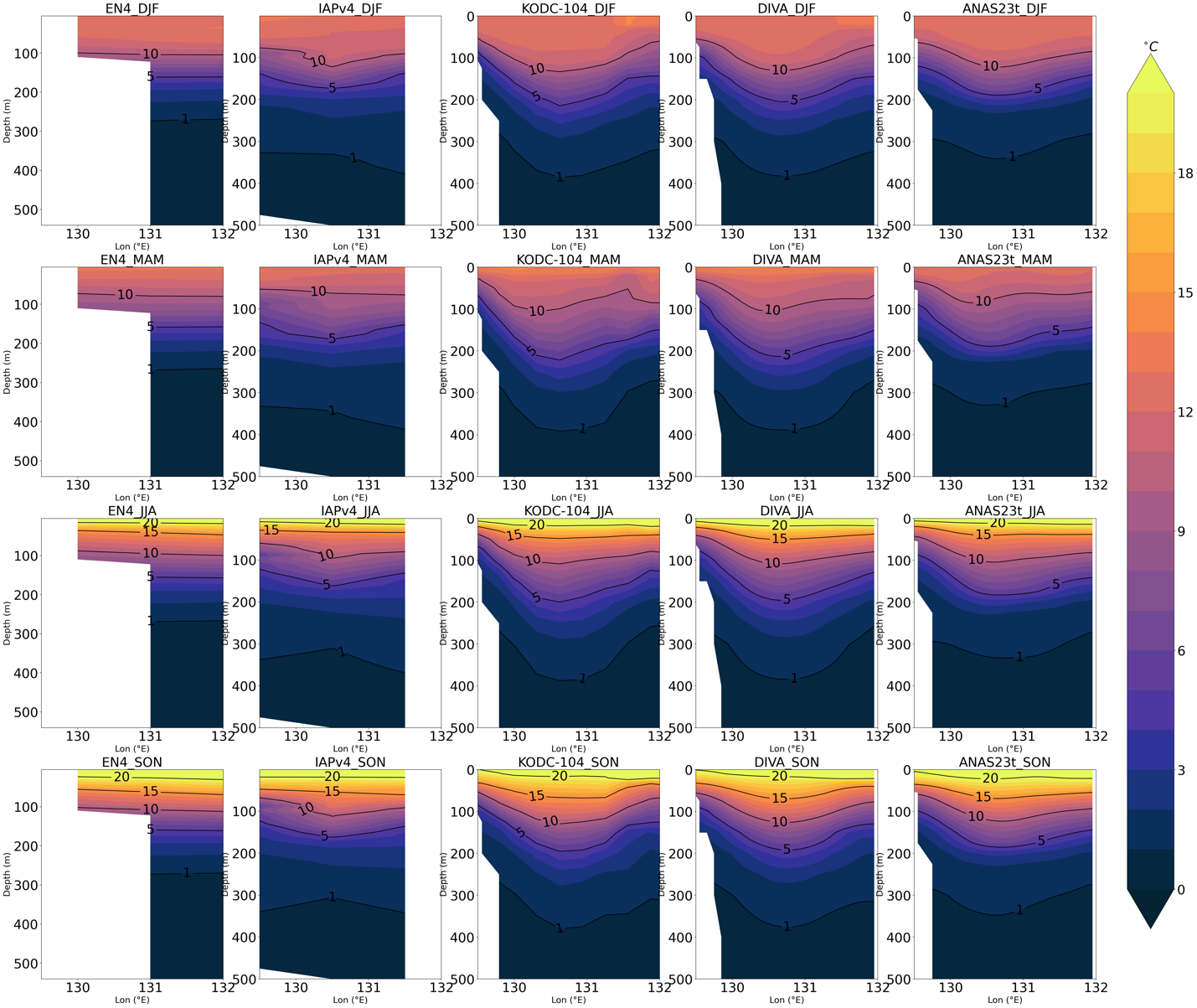
(3) KODC 104 line before horizontal interpolation, (4) DIVA results, and (5) ANAS23t.

(3) KODC 104 line before horizontal interpolation, (4) DIVA results, and (5) ANAS23t.