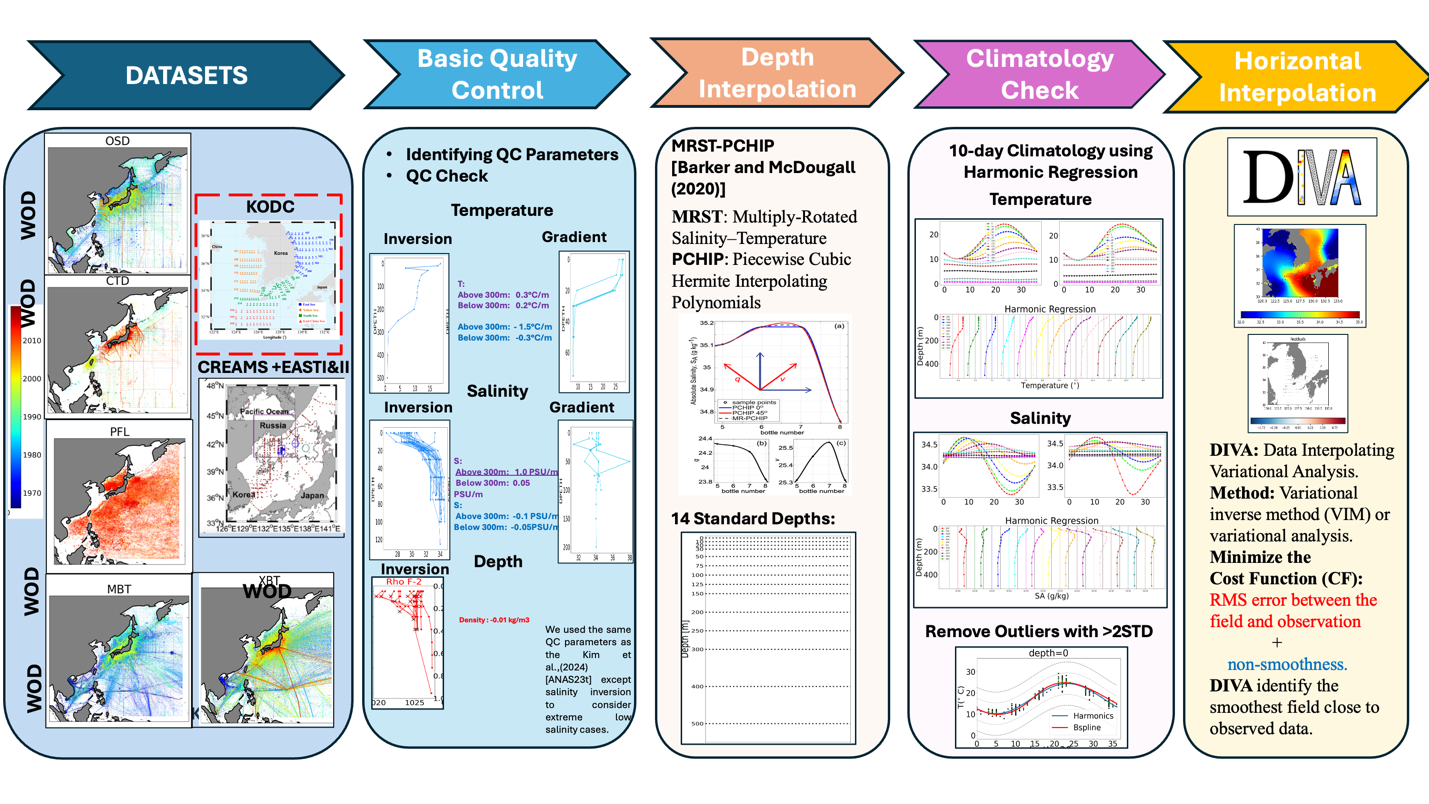
This study employed the following four-step procedure to transform approximately 60 years of serial oceanographic observation data into a reliable ocean climate dataset.
01
Basic Quality Control (QC)
The observed temperature and salinity values were validated to ensure they fall within physically plausible ranges, and anomalous data such as temperature–salinity inversions were removed to ensure data reliability.
02
Vertical Interpolation (Depth Interpolation)
To populate values at 14 standard depth levels (0–500 m), the state-of-the-art MRST-PCHIP method was applied, ensuring physically realistic correction of temperature and salinity structures at each depth.
03
Calculation of Climatological Means (10-day Intervals)
Using harmonic regression, climatological mean fields at 10-day intervals (37 time points per year) reflecting seasonal variability were generated, and anomalous data deviating from the climatological values were re-examined and subsequently removed.
04
Spatial Interpolation (DIVA)
Using DIVA (Data-Interpolating Variational Analysis), which accounts for bathymetry and coastline geometry, high-resolution gridded time-series data of temperature and salinity at a 1/12° resolution were constructed.